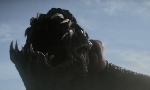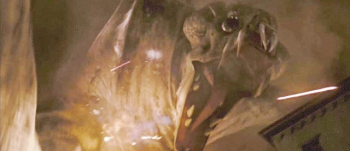

The parasitic organisms associated with the Cloverfield Monster are among the most dangerous and unsettling elements of the Cloverfield incident. Though significantly smaller than their host, these creatures pose a direct threat to humans and contribute heavily to the chaos seen during the attack on New York City.
Often overlooked in favor of the larger creature, the parasites provide important insight into the biology and ecosystem from which the monster originates.

Physical Description
The parasites are small, agile creatures that detach from the body of the Cloverfield Monster and operate independently. They possess elongated limbs, sharp features and the ability to move quickly through confined spaces such as subway tunnels and underground infrastructure.
Their appearance suggests a predatory nature, adapted for close-range attacks and rapid movement.

Behavior and Aggression
Unlike the larger creature, which displays signs of confusion, the parasites exhibit direct and focused aggression toward humans. They actively pursue targets and attack with little hesitation.
This behavioral difference has led to the theory that the parasites function as a defensive extension of the host, engaging threats that the larger creature cannot directly address.
Alternatively, they may operate independently as opportunistic predators within the same ecosystem.
Biological Function
The exact role of the parasites within the creature’s biology remains unclear. One possibility is that they are true parasites, feeding off the host while also benefiting from its protection and mobility.
Another interpretation suggests a symbiotic relationship, where both the host and the smaller organisms benefit from one another. In this scenario, the parasites may help defend the host or contribute to its survival in hostile environments.
Their ability to detach and act independently indicates a highly evolved and adaptable lifeform.
Infection and Effects on Humans
Encounters with the parasites often result in severe consequences for humans. Individuals attacked by these organisms exhibit rapid physical deterioration, suggesting the possibility of venom, infection or internal trauma.

The exact mechanism behind these effects is not fully explained, but the speed at which symptoms appear indicates a highly potent biological agent.
This aspect of the parasites adds a secondary layer of danger to the Cloverfield incident, extending the threat beyond the immediate destruction caused by the larger creature.
Part of a Larger Ecosystem
The presence of parasitic organisms strongly suggests that the Cloverfield Monster is not an isolated entity, but part of a broader and more complex ecosystem. These creatures may represent just one component of a deep-sea environment that remains largely unexplored.
If additional organisms exist within this ecosystem, the implications for future encounters could be far greater than a single creature event.
Expanding the Threat
While the Cloverfield Monster dominates attention, the parasites demonstrate that the true danger lies in the unknown biology behind it. Their existence raises questions about how many other organisms may exist and what role they play within the larger system.
In this way, the parasites transform the Cloverfield incident from a singular disaster into a glimpse of something much larger — a hidden world of interconnected lifeforms brought to the surface.
Published 2d ago • Last Updated: 2d ago