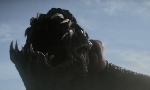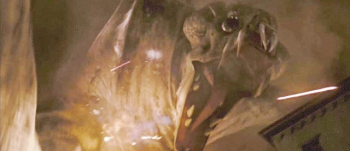

The creature featured in Cloverfield (2008), commonly referred to as Clover or the Cloverfield Monster, is one of the most mysterious and widely debated entities in modern science fiction. Its sudden appearance, immense size and unusual biological traits have led to numerous interpretations regarding its origin and purpose within the Cloverfield universe.
Rather than being a traditional movie monster, the creature is presented as an unknowable organism — one that may have existed long before humanity and was brought into conflict with the surface world through human interference.
Origin and Awakening
The most widely accepted explanation for the creature’s emergence is tied to Tagruato Corporation and its deep-sea drilling operations conducted through Bold Futura. The destruction of the Chuai Station shortly before the events in New York City strongly suggests that the creature was either awakened or disturbed by these activities.
Rather than being created artificially, the monster is believed to have existed deep beneath the ocean floor, possibly in a dormant or isolated state. The intrusion caused by drilling operations may have forced it to the surface, disoriented and reacting to an unfamiliar environment.
This interpretation positions the creature not as an invader, but as a displaced organism responding to external disruption.
Size and Development
The Cloverfield Monster is depicted as a massive, towering organism capable of moving rapidly through an urban environment. However, official material and commentary suggest that the creature seen in the film may not be fully grown.

This had led to the theory that the monster is a juvenile specimen, with the potential to grow significantly larger over time. Its behaviour — including signs of distress and lack of coordinated movement — supports the idea that it is not operating at full maturity.
This theory was later confirmed when director of the original Cloverfield, Matt Reeves, acknowledged that the monster from the first film was in fact only a baby!
Physical Characteristics
The creature’s anatomy is highly unconventional, combining traits that do not clearly align with any known classification of life. It possesses a large, elongated body supported by multiple limbs, allowing it to navigate both land and water.

Its skin appears armored yet flexible, capable of withstanding military attacks while still allowing for mobility. The creature’s head structure suggests limited visual capability, leading some to theorize that it may rely on alternative sensory systems such as vibration detection or sound.

Despite its size, the creature demonstrates agility and speed, indicating a physiology adapted for survival in extreme environments.

Behavior and Motivation
One of the most notable aspects of the Cloverfield Monster is its behavior. Rather than displaying calculated aggression, the creature appears confused, reactive and at times erratic.
Its movements through New York City suggest a state of distress, as though it is attempting to navigate an unfamiliar environment while under constant attack. This has led to the interpretation that its destructive actions are not driven by intent to harm, but by panic and self-preservation.
This perspective reinforces the idea that the creature is not inherently hostile, but has been forced into conflict with humanity.
Parasitic Organisms
A defining feature of the Cloverfield Monster is the presence of smaller parasitic creatures that detach from its body and attack humans. These organisms play a significant role in the overall threat posed during the incident.

The parasites appear to function as an extension of the host creature’s biology, possibly serving as a defensive mechanism or part of a larger symbiotic relationship. Their aggressive behaviour toward humans suggests they are adapted to protect the host or spread biological influence.
The existence of these parasites adds another layer of complexity to the creature’s biology, indicating that it may be part of a larger ecosystem rather than a solitary organism.
Military Response and Resilience
During the events of Cloverfield (2008), the creature is subjected to sustained military assault, including conventional weapons and aerial bombardment. Despite this, it continues to move and function, demonstrating an extraordinary level of durability.
This resilience suggests that the creature evolved in an environment where extreme pressure or hostile conditions were common, further supporting the theory of a deep-sea origin.
Ultimately, the full extent of its survivability remains unclear, as the outcome of the military response is left ambiguous.

A Creature Beyond Understanding
The Cloverfield Monster is intentionally left unexplained in many respects, reinforcing the franchise’s central theme of uncertainty. Its origin, lifecycle and true nature remain open to interpretation, allowing it to exist as both a physical threat and a symbol of the unknown.
Rather than providing definitive answers, the Cloverfield universe presents the creature as a consequence of human actions — a reminder that there are forces beyond our understanding, waiting beneath the surface.
Published 2d ago • Last Updated: 2d ago